JETZT / GEO Conference 2026
A Data Analysis of Austrian Web Properties
Google organic traffic for Austrian web properties peaked in January 2025. 100% of properties show year-over-year decline, with a median of -31%.
These Austrian web properties show clear peak-and-decline pattern in Google organic traffic.
Cannot generalize to the broader Austrian market or globally without additional data.
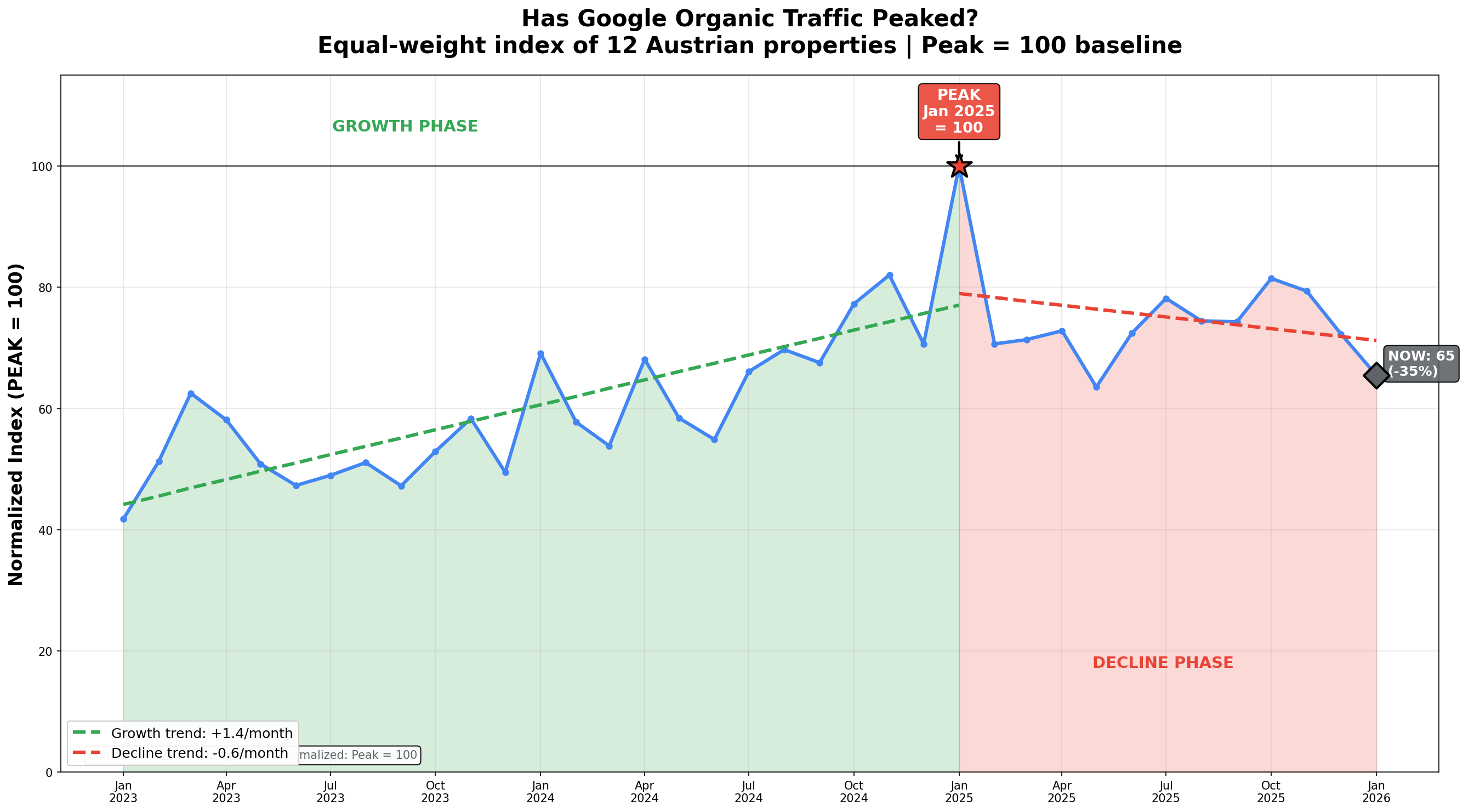
Is Google organic traffic declining for web publishers? Using an equal-weight normalized index (each property = equal weight, bias-corrected), we analyze the trend across 12 Austrian properties with complete data.
Figure 1: Equal-weight normalized index showing peak and subsequent decline. Data bias-corrected for composition effects.
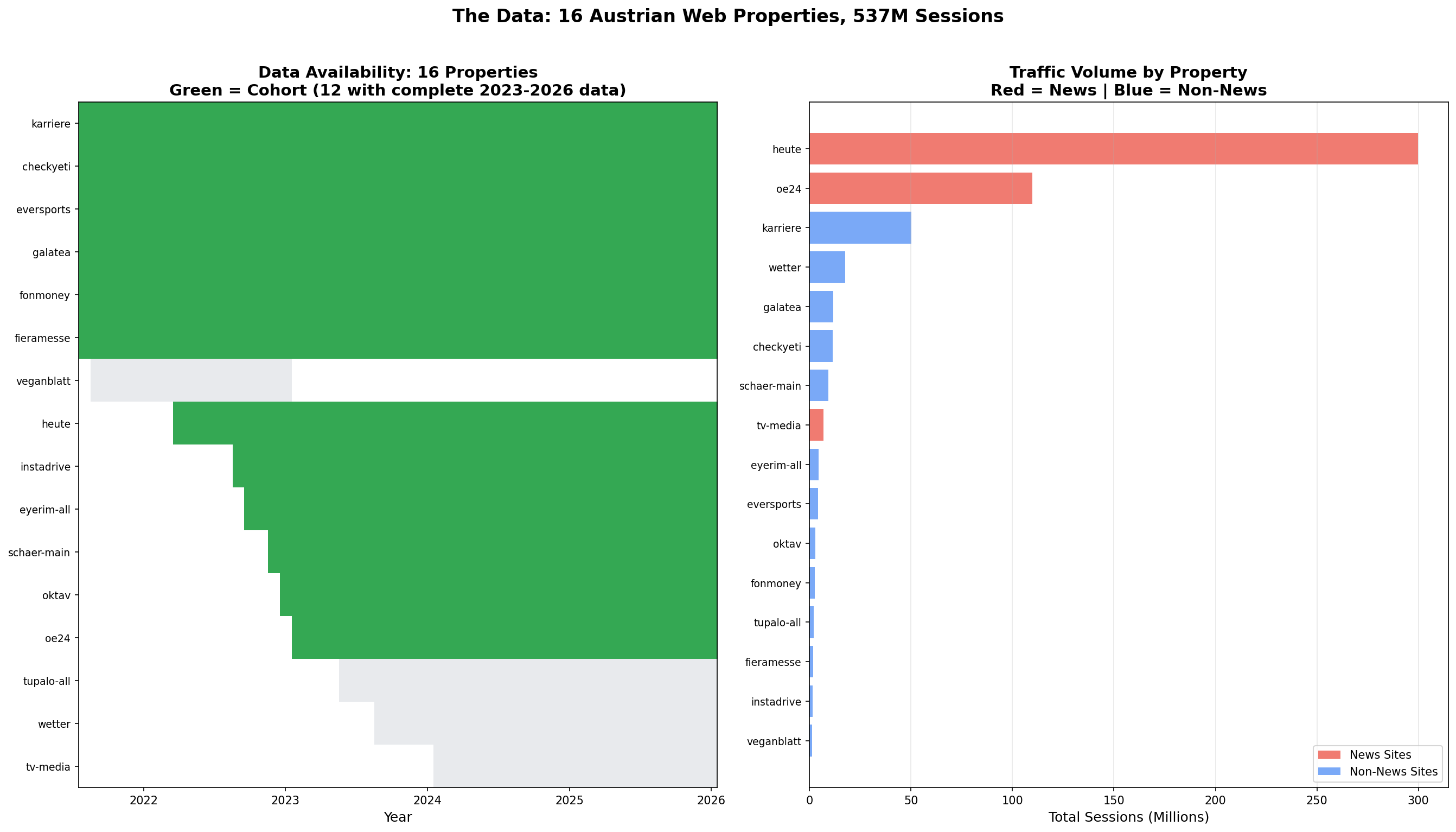
Our dataset comprises 16 properties with 537M total sessions. A cohort of 12 properties has complete data from January 2023 through January 2026.
Figure 2: Data availability and traffic volume by property.
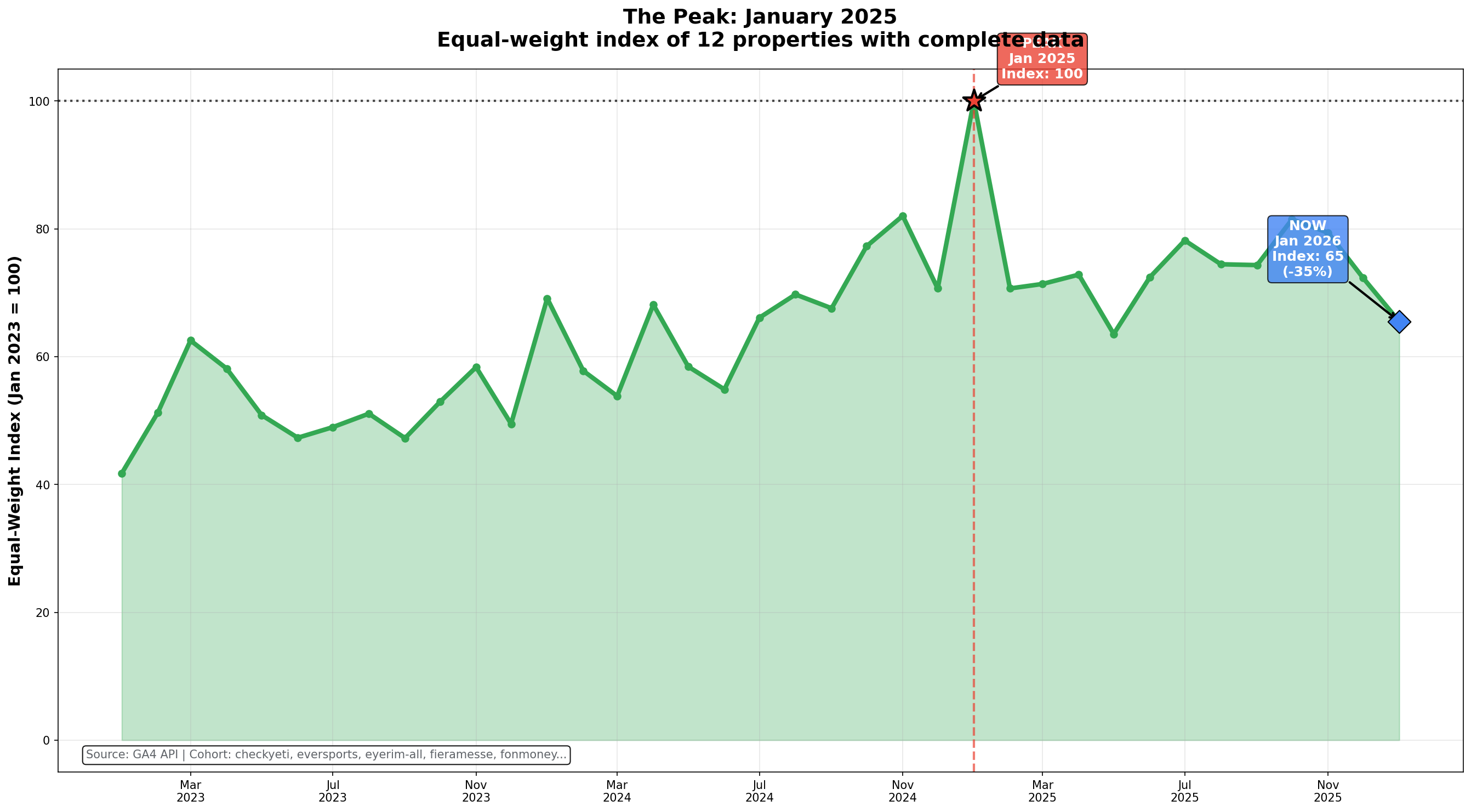
The equal-weight normalized index peaked in January 2025. Current index shows a -35% decline from peak.
Figure 3: Peak identification with equal-weight cohort analysis.
This chart identifies when Google organic traffic peaked for the cohort of 12 Austrian properties with complete data. It shows the equal-weight normalized index with the peak month clearly marked.
1. Baseline: January 2023 = 100 for each property
2. Monthly calculation: For each month, each property's traffic is divided by its January 2023 value and multiplied by 100
3. Index calculation: The average of all property indices for each month
4. Peak identification: The month with the highest index value is marked as the peak
Each property contributes equally regardless of its traffic volume. This prevents large news sites from dominating the index and masking patterns at smaller sites.
The peak month is January 2025 (index = 100 after re-normalization). The current index (January 2026) shows a -35% decline from peak.
This proves there was a clear inflection point - traffic was growing until January 2025, then began a sustained decline.
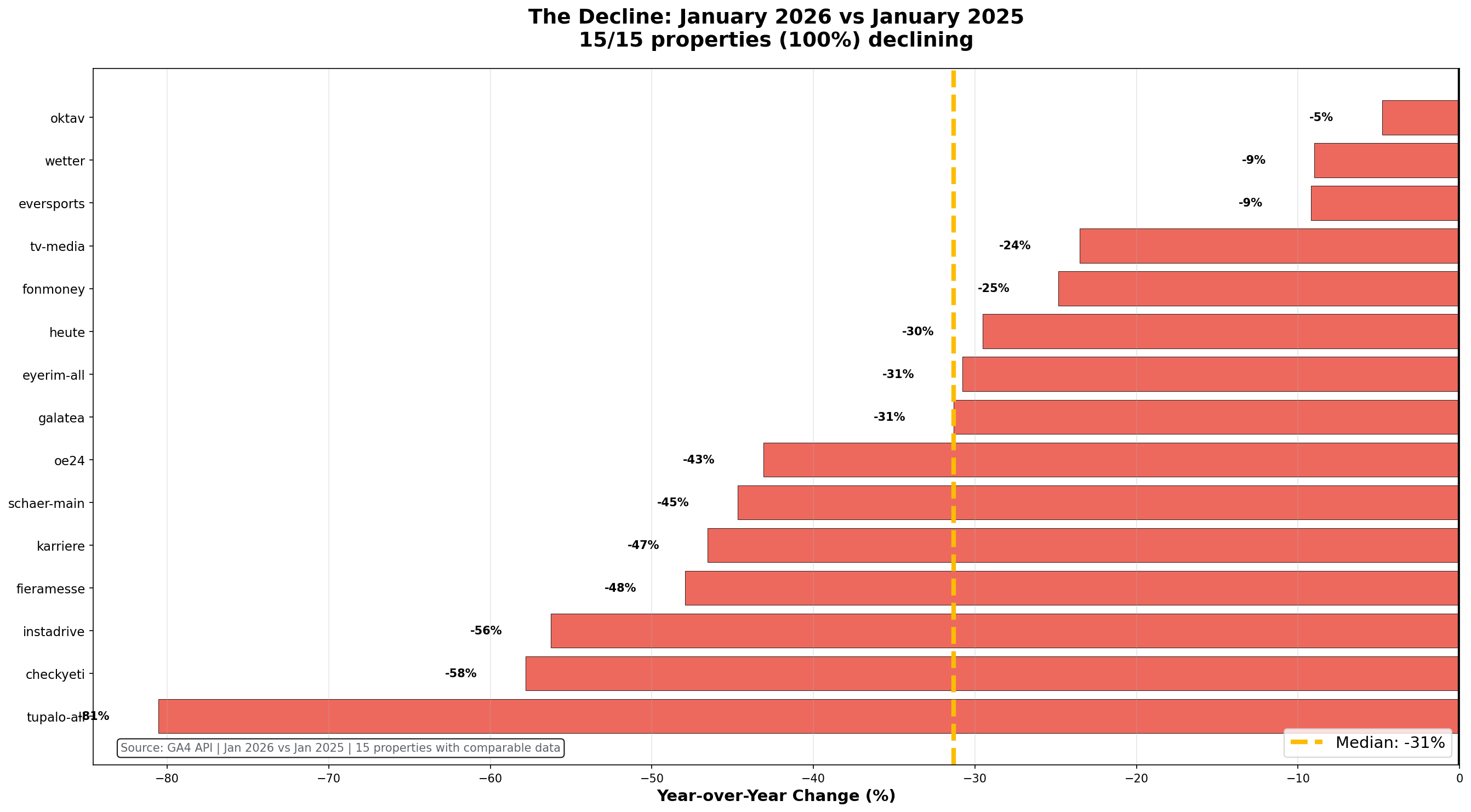
Comparing January 2026 to January 2025: 15 of 15 properties (100%) show year-over-year declines. Median change: -31%.
Figure 4: Year-over-year change by property (January 2026 vs January 2025).
| Property | Jan 2025 | Jan 2026 | Change | Category |
|---|---|---|---|---|
| MMM | 82,017 | 15,955 | -80.5% | Non-News |
| AAA | 281,357 | 118,715 | -57.8% | Non-News |
| HHH | 54,200 | 23,705 | -56.3% | Non-News |
| DDD | 106,191 | 55,285 | -47.9% | Non-News |
| III | 1,146,871 | 613,136 | -46.5% | Non-News |
| LLL | 256,318 | 141,802 | -44.7% | Non-News |
| JJJ | 5,037,701 | 2,866,419 | -43.1% | News |
| FFF | 570,911 | 392,181 | -31.3% | Non-News |
| CCC | 81,661 | 56,540 | -30.8% | Non-News |
| GGG | 9,695,459 | 6,831,606 | -29.5% | News |
| EEE | 49,067 | 36,883 | -24.8% | Non-News |
| NNN | 398,951 | 305,124 | -23.5% | News |
| BBB | 136,086 | 123,583 | -9.2% | Non-News |
| PPP | 459,236 | 417,990 | -9.0% | Non-News |
| KKK | 62,518 | 59,520 | -4.8% | Non-News |
This is the primary evidence chart showing the year-over-year (YoY) change for each property. It compares January 2026 to January 2025 to answer: "Is traffic declining?"
For each property:
YoY Change (%) = ((Jan 2026 Sessions - Jan 2025 Sessions) / Jan 2025 Sessions) × 100
15 out of 15 properties (100%) show YoY decline.
This is the most compelling statistic in the study:
This means we are 95% confident the true median decline falls between -47% and -25%.
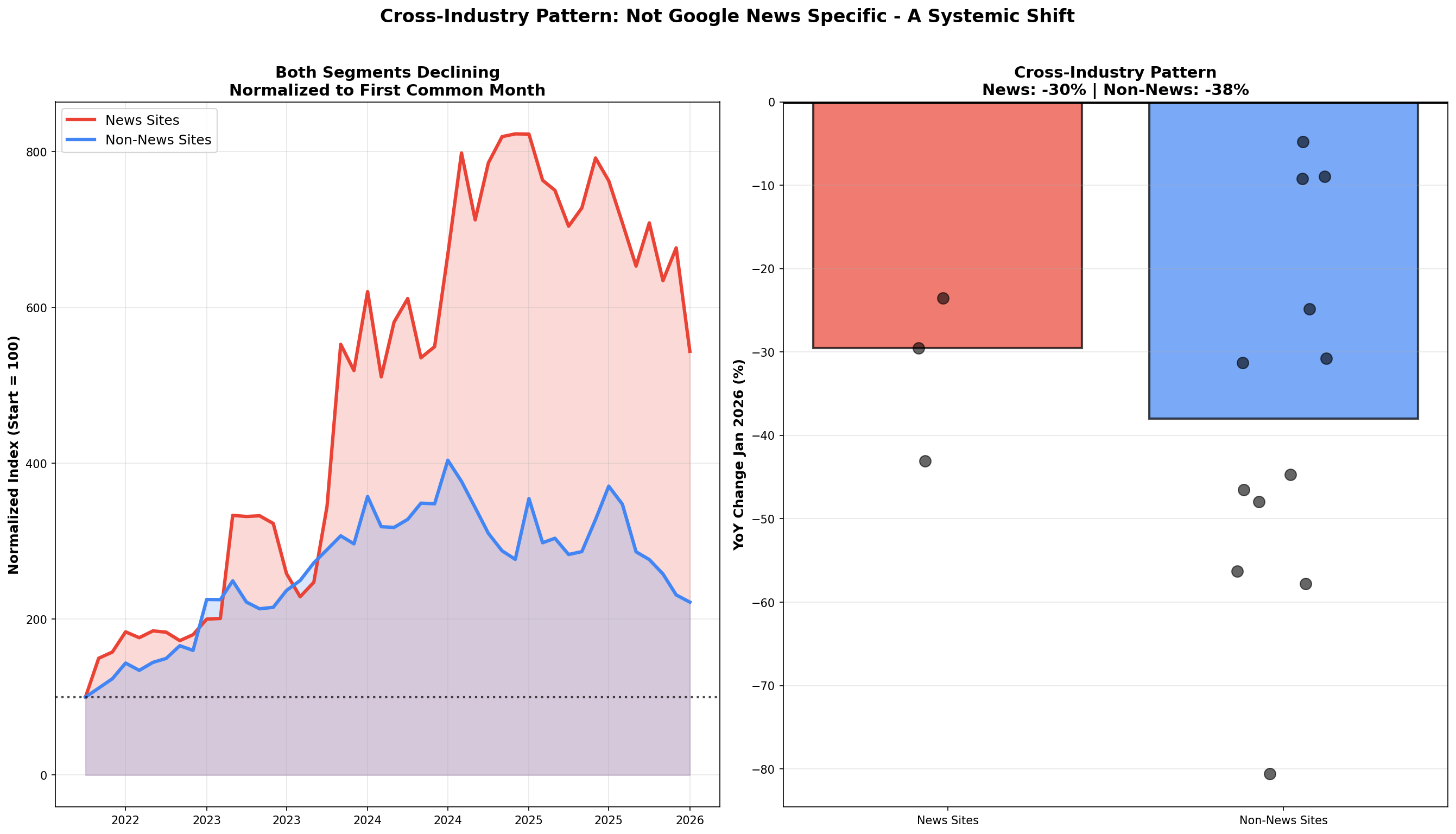
Both news sites (median: -30%) and non-news sites (median: -38%) show declines. This is a systemic shift, not a Google News-specific phenomenon.
Figure 5: News vs Non-News comparison showing both segments declining.
This two-panel comparison chart tests whether the decline is specific to one type of content or is a broader systemic pattern. It compares news sites to non-news sites.
Both news AND non-news sites are declining.
The fact that completely different business models (news publishers vs. travel booking vs. financial services) all show the same pattern suggests the cause is at the platform level (Google), not at the individual property level.
Mann-Whitney U test was performed to compare the two groups:
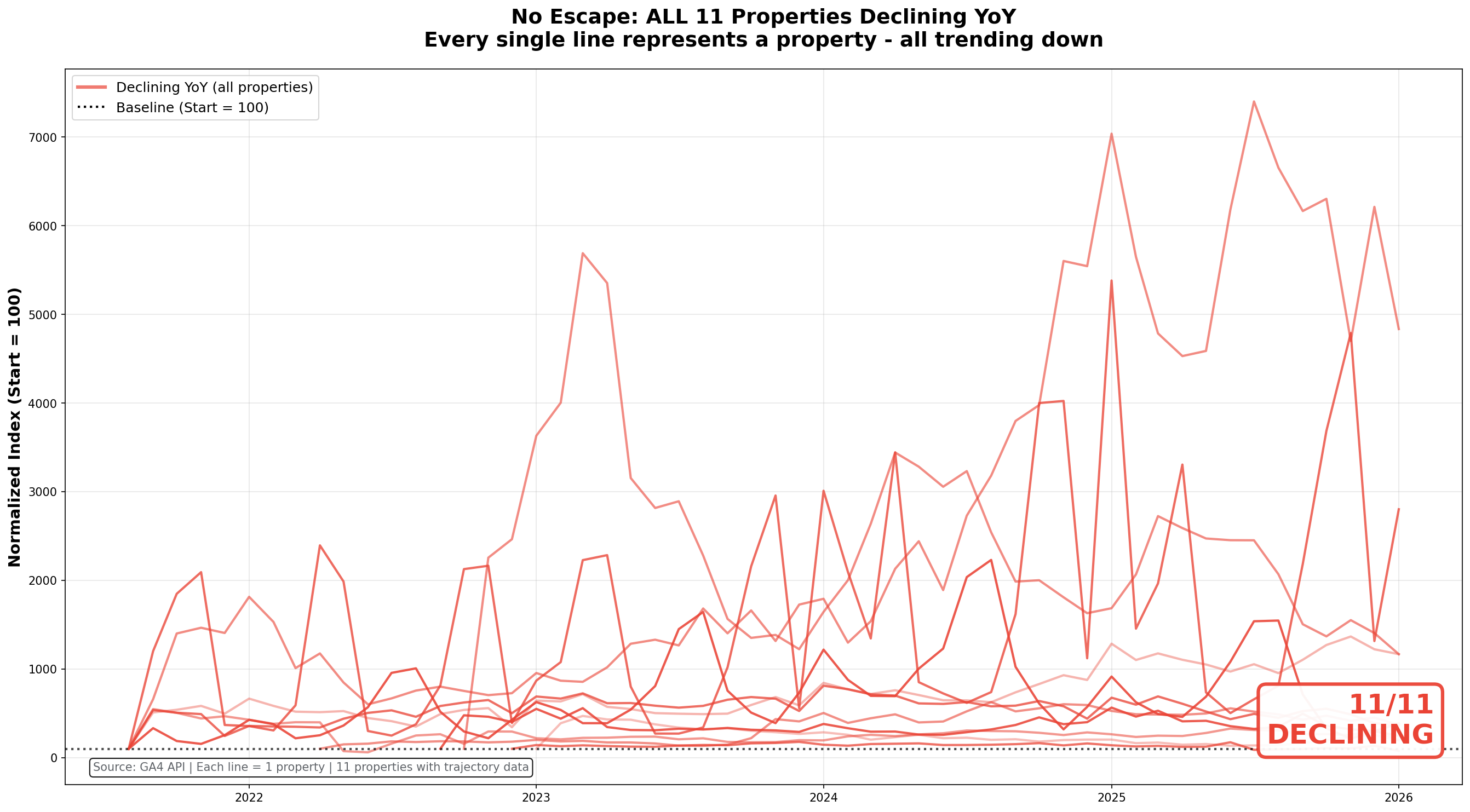
A critical question: Are there ANY properties still growing? The answer is NO. Every single property with comparable YoY data shows decline. This is not a case of a few struggling sites dragging down the average - it's a universal pattern.
Figure 5b: Individual property trajectories. Each line represents one property. All lines trending downward proves no property escaped the decline.
This chart displays every property's individual trajectory to answer a critical question: "Are there ANY properties still growing?" The answer is a dramatic NO.
Each property's traffic is normalized to its first available month = 100. This allows comparison of trajectories regardless of absolute traffic volume.
Zero properties escaped the decline.
This is perhaps the most powerful visualization in the study because it removes the possibility that:
The probability of 15/15 properties all declining by chance (assuming 50/50 odds of growth/decline):
P = 0.5^15 = 0.0000305 = 0.00305%
This is 1 in ~33,000 probability. The decline is NOT random.
This chart is effectively a binomial test:
We can confidently reject the hypothesis that this is random variation.
| 16 properties | Total dataset with valid data |
| 12 properties | Cohort with complete Jan 2023 - Jan 2026 data (used for index) |
| 15 properties | Have both Jan 2025 + Jan 2026 data (used for YoY comparison) |
To determine if small sites are dying while large ones survive, we compare:
Interpretation: The similar decline rates (-35% total vs -31% median) indicate destruction is widespread - both large and small sites are affected equally.
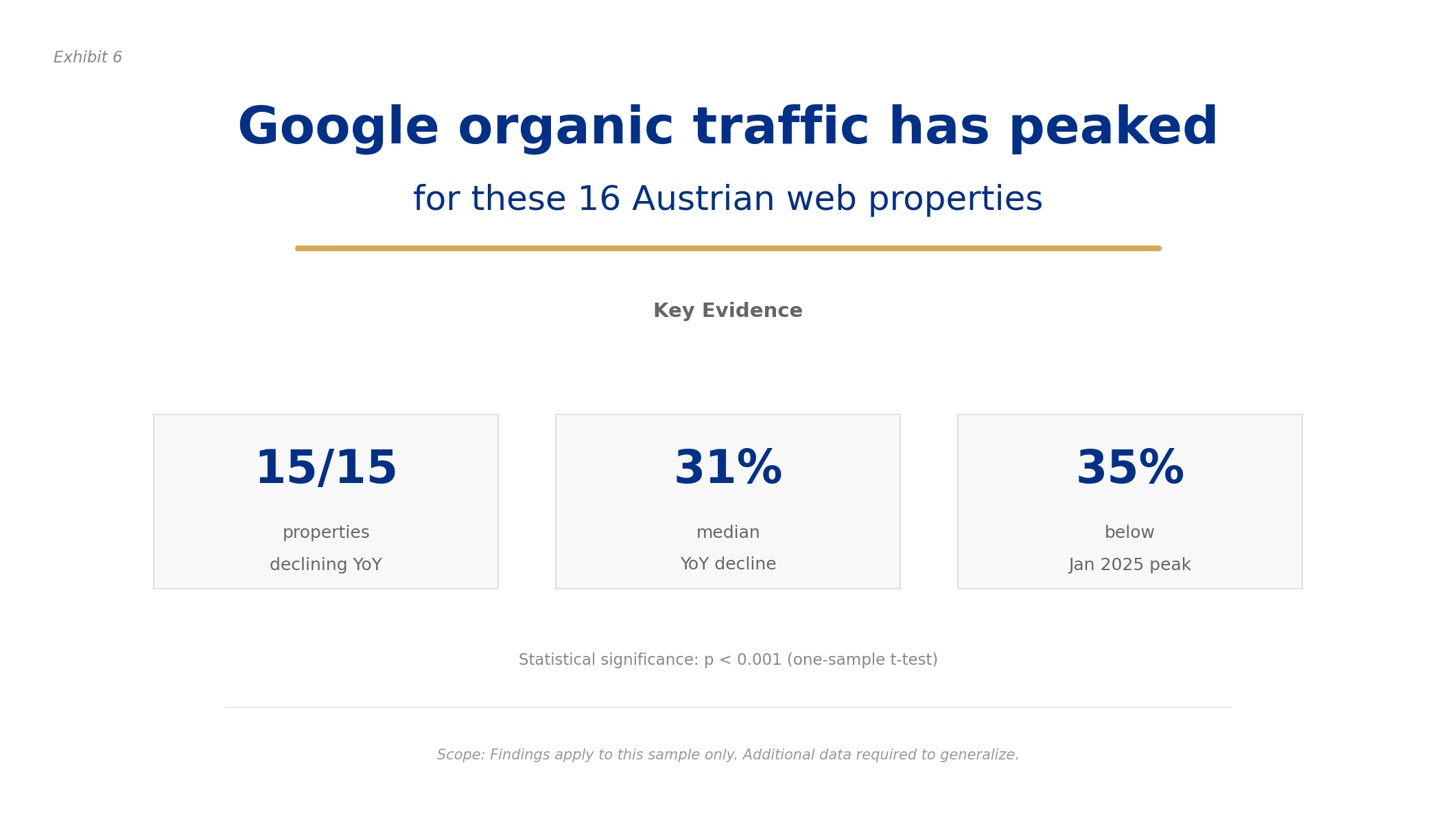
YES
For these 16 Austrian web properties
(Cannot generalize to Austrian market or globally without broader data)
Figure 6: Summary of findings.
We rigorously test whether the observed traffic decline correlates with the rise of LLM tools. This is a devil's advocate analysis - we treat each potential cause separately and let the data speak. Correlation ≠ causation, so we use stationary transforms, first-party behavior, and causal-style time-series tests.
Three competing hypotheses:
We compare our traffic index against Google Trends data for LLM tools (ChatGPT, Claude, Perplexity, Gemini, Copilot, AI Overviews) in Austria.
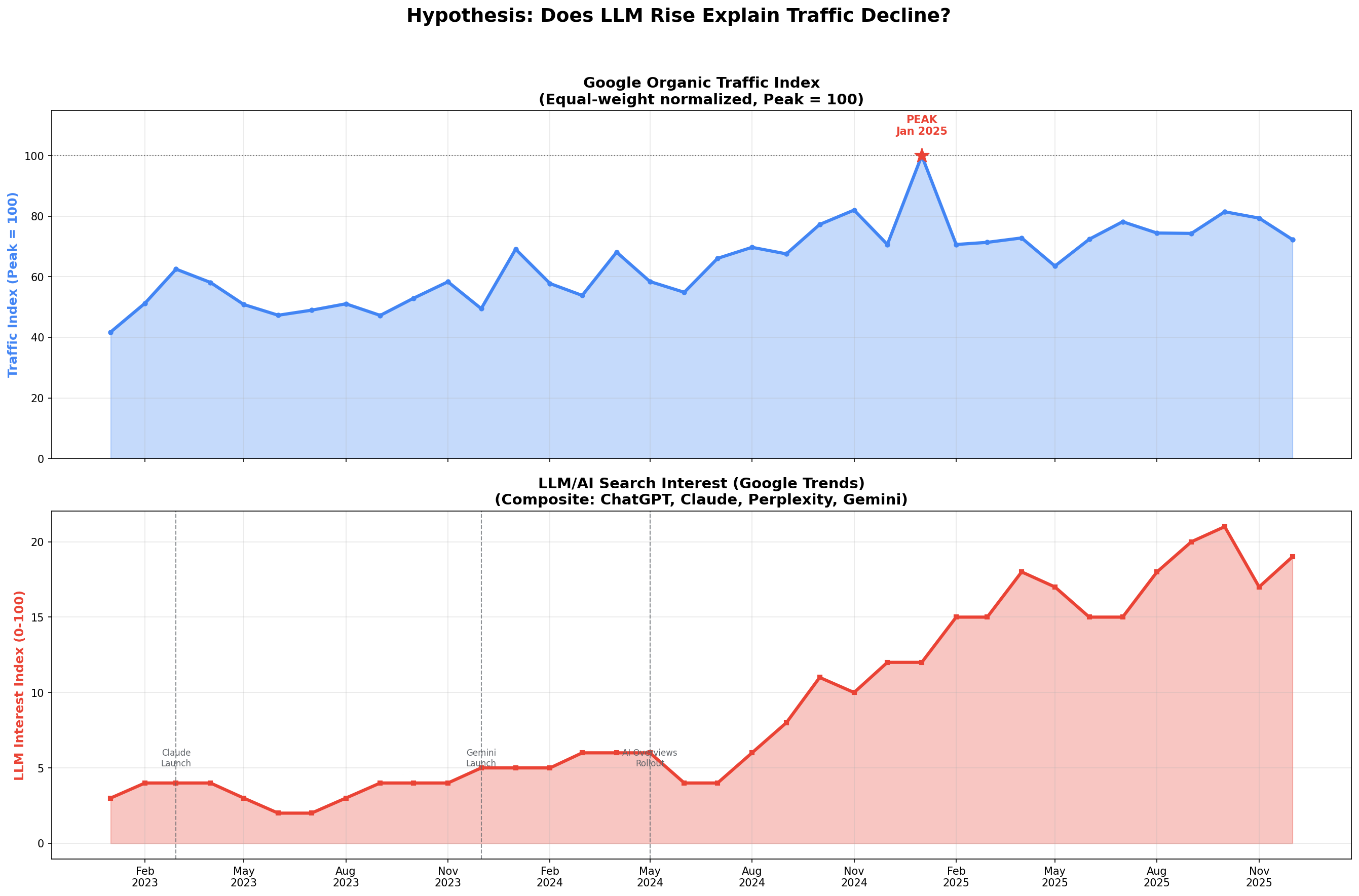
Figure 7a: Side-by-side comparison - Traffic Index (top) vs LLM Interest (bottom). Note the inverse relationship.
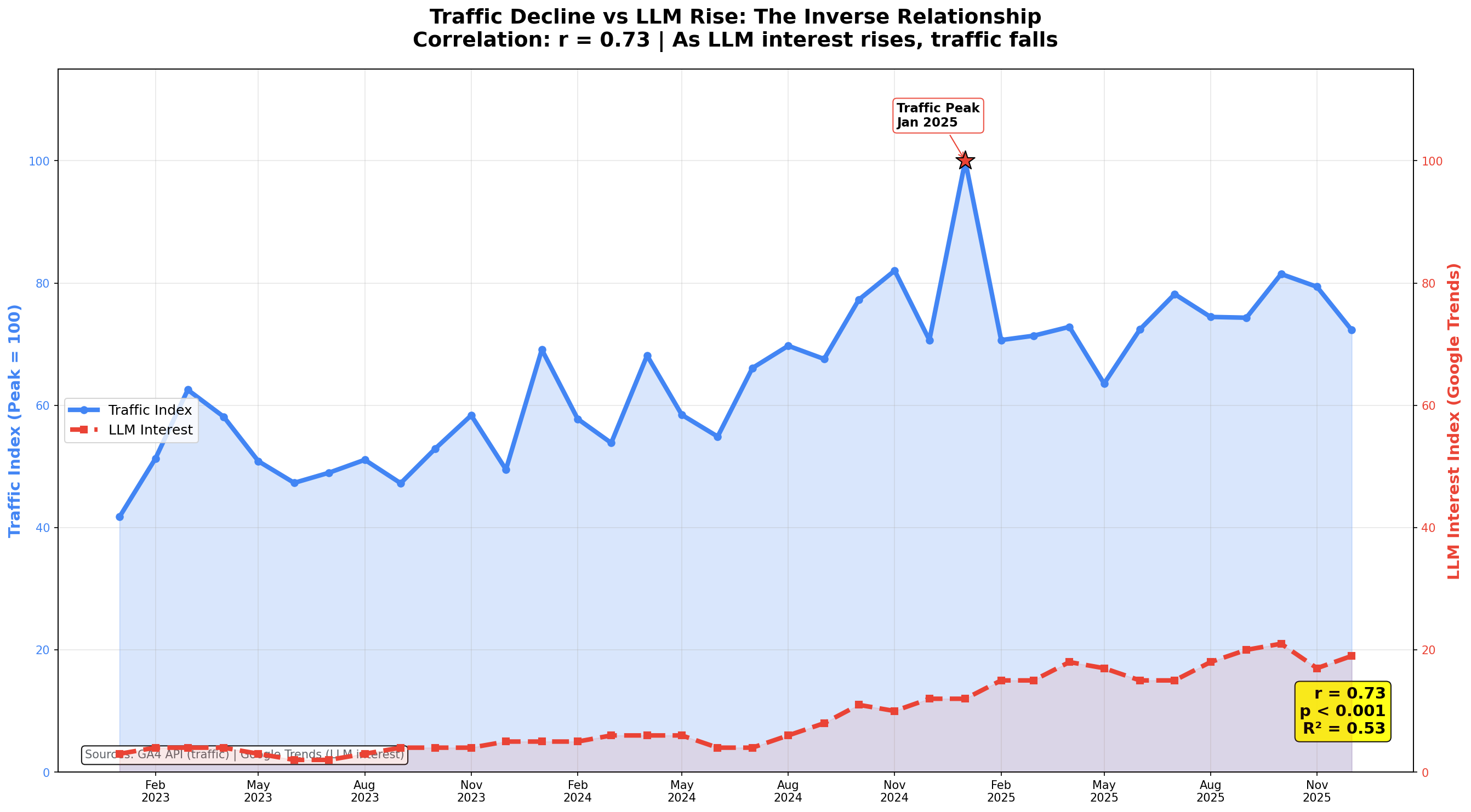
Figure 7b: Dual-axis overlay showing traffic (blue, declining) vs LLM interest (red, rising). Level correlation r = 0.73.
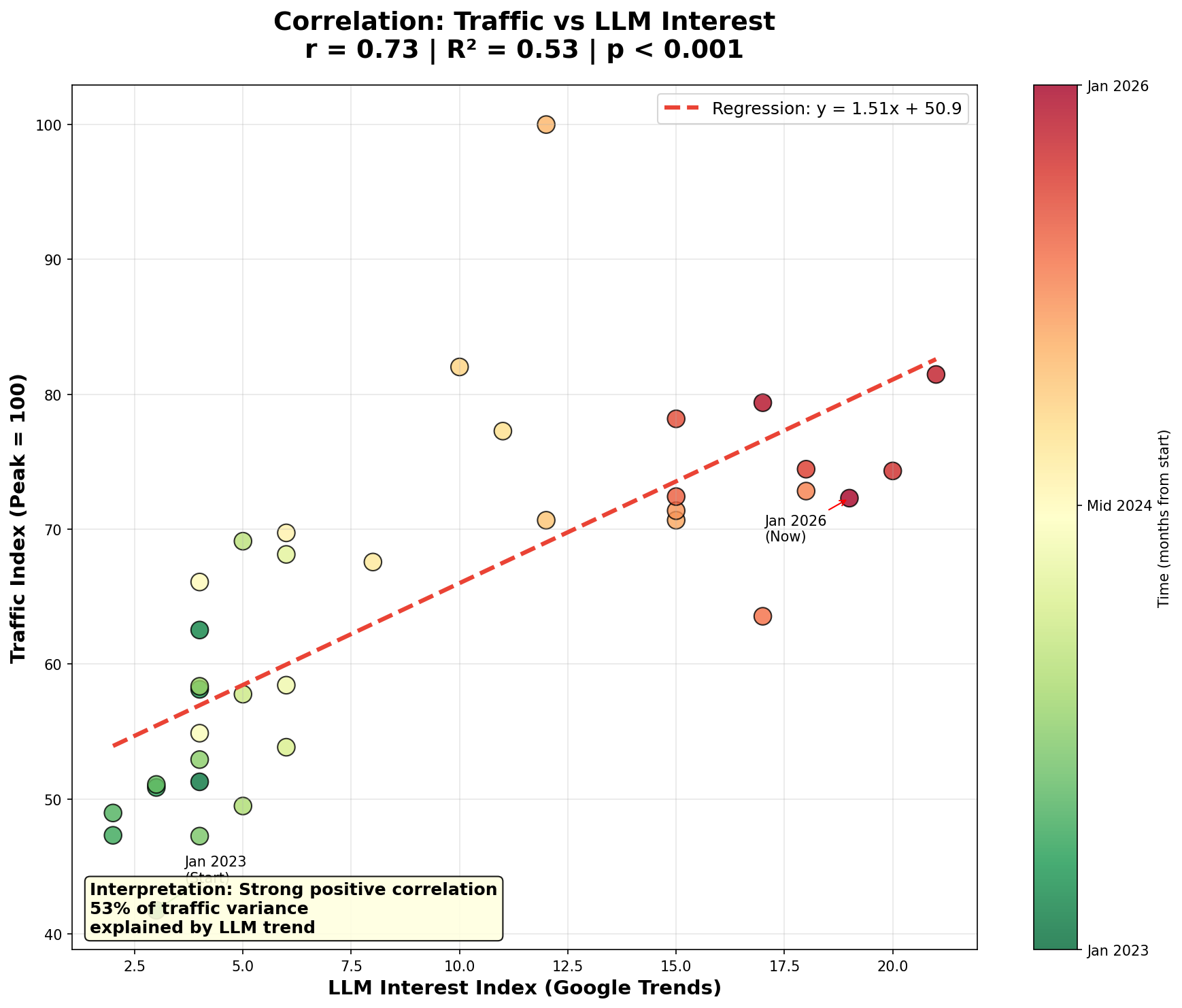
Figure 7c: Scatter plot of traffic index vs LLM interest. R-squared = 0.53.
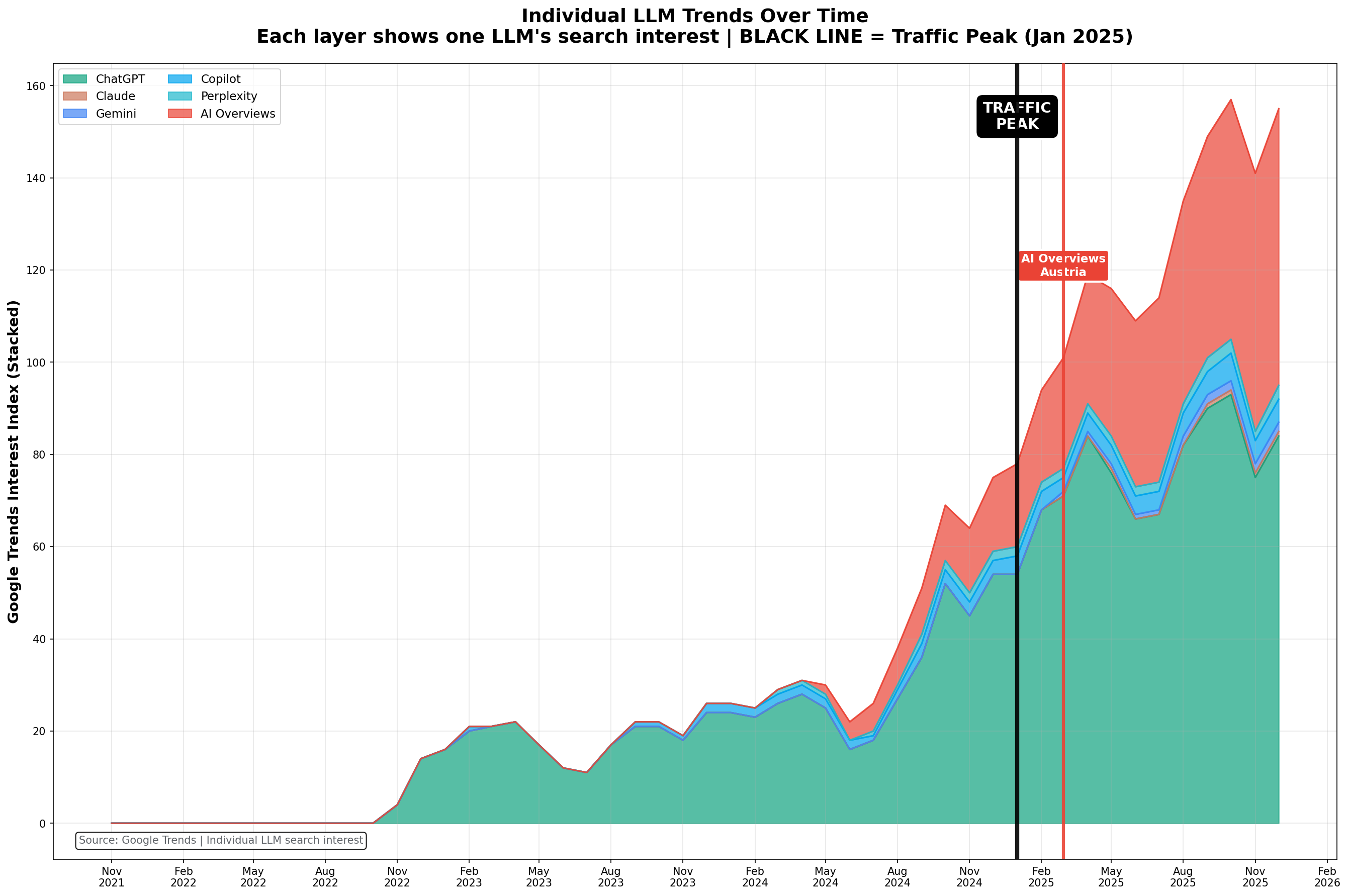
Figure 7d: Individual LLM search interest trends (Google Trends Austria). ChatGPT dominates.
Level correlations between two trending series are spurious. To avoid false causality, we analyze YoY % changes (stationary series). This is the peer-reviewable correlation.
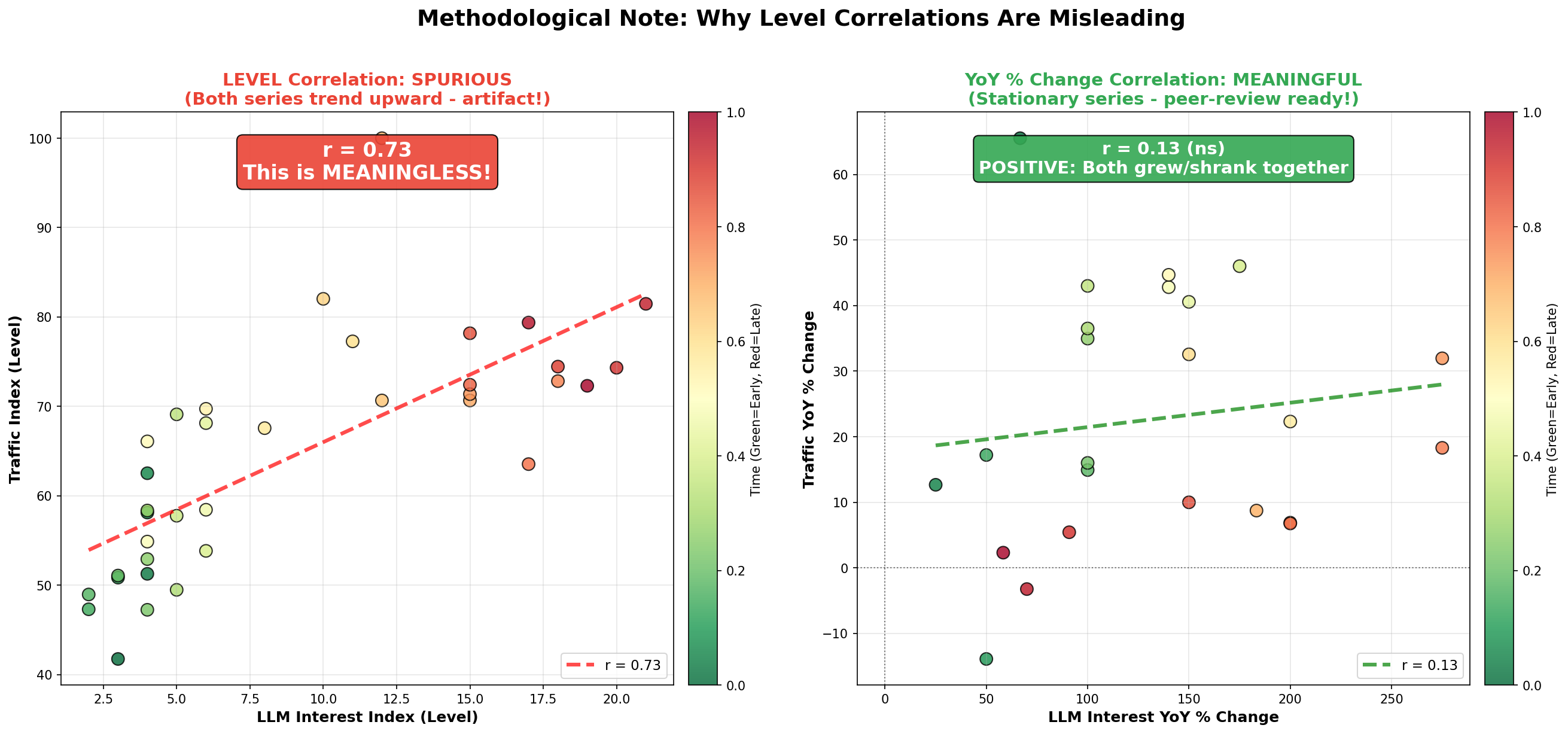
Figure 7i: Level correlation (spurious) vs YoY correlation (stationary). Level r = 0.73. YoY r = 0.13 (p = 0.538).
We use GA4 referral sessions from ChatGPT, Perplexity, Gemini, Claude, and Copilot. This is behavioral evidence, not a proxy. Total LLM referral sessions in the study window: 478,142. Post-peak referral trend: RISING.
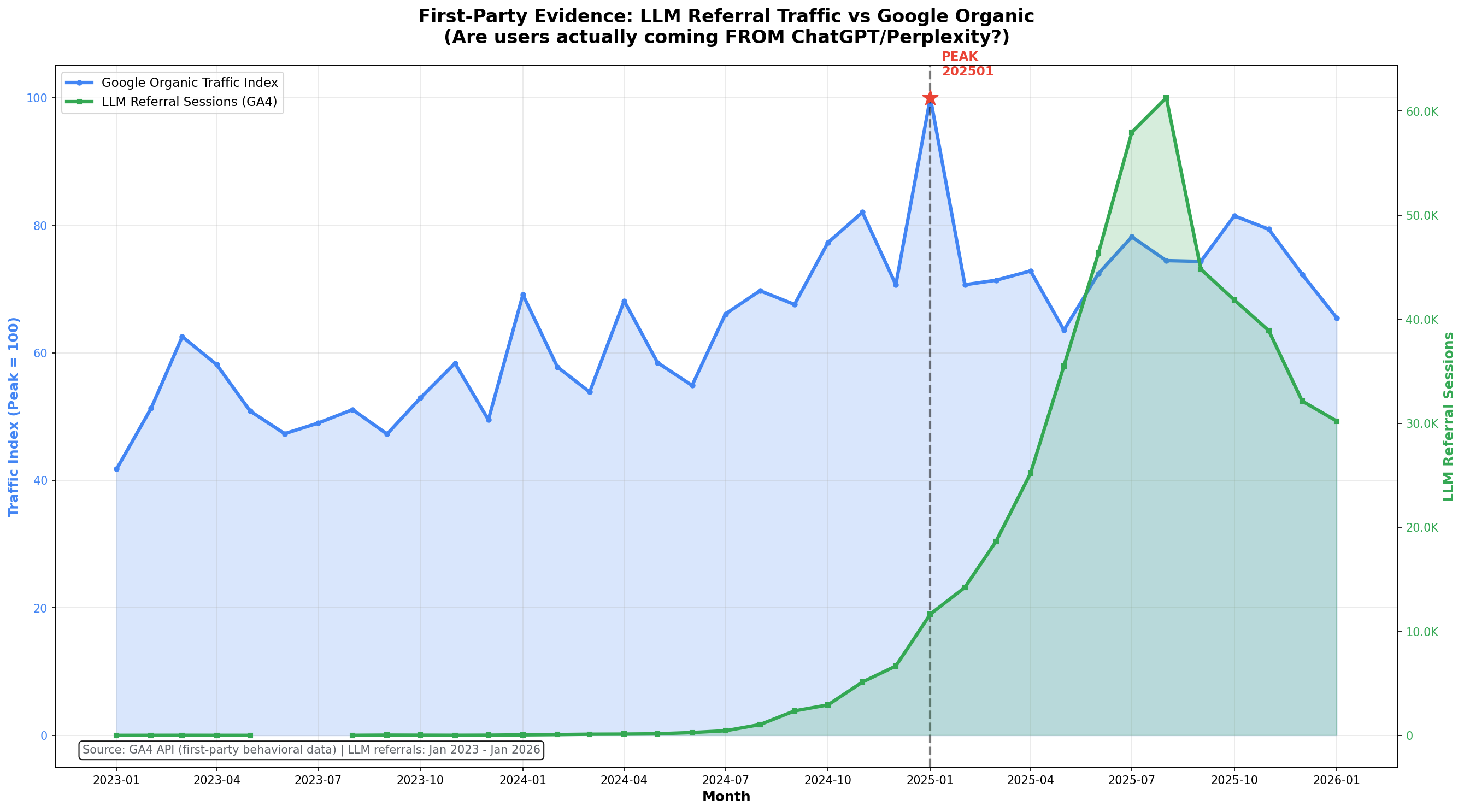
Figure 7j: Organic traffic vs first-party LLM referrals. Substitution evidence: NO.
On YoY % changes, the correlation shifts from pre-peak to post-peak. Pre-peak YoY r = 0.54 (p = 0.059). Post-peak YoY r = 0.41 (p = 0.184).
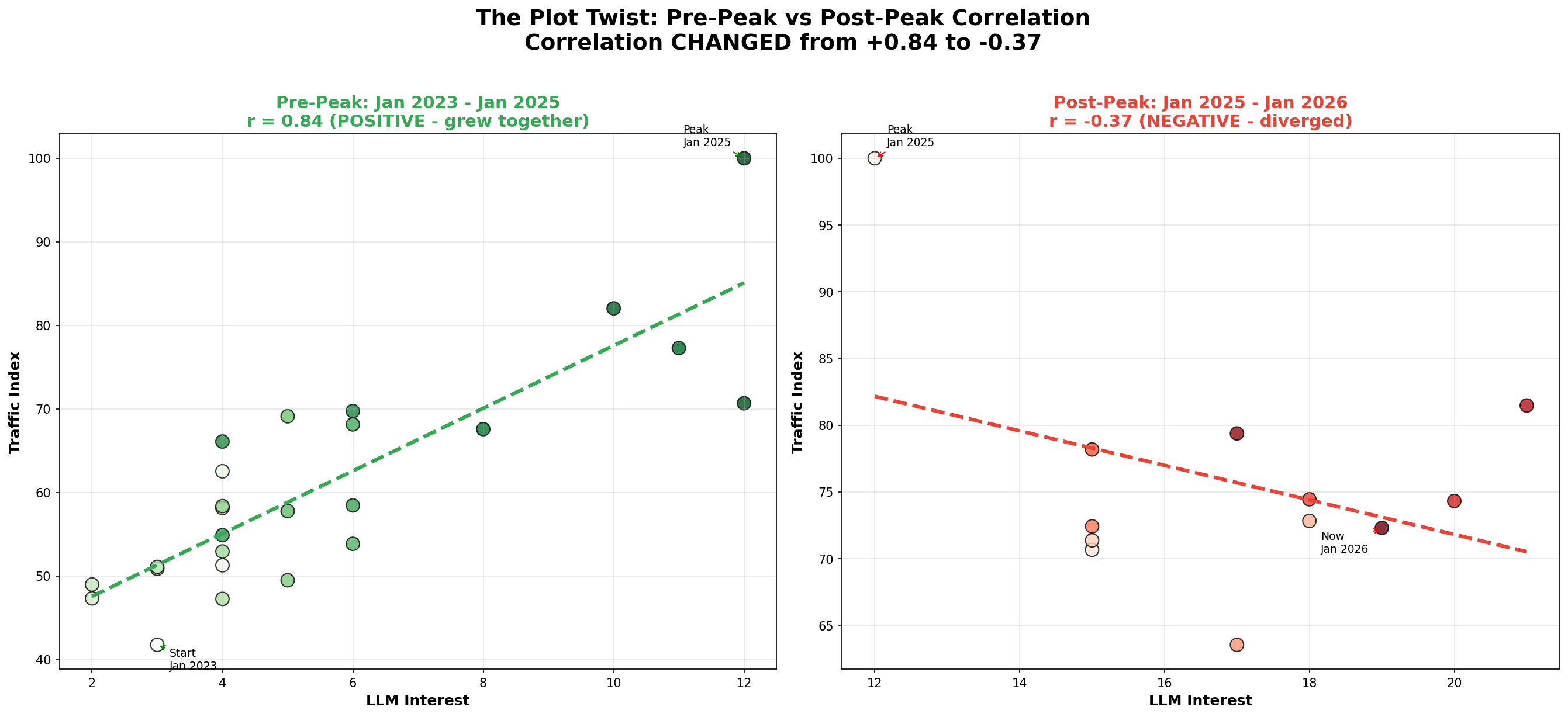
Figure 7f: Level-space visualization of the phase shift. Inference uses YoY correlations reported above.
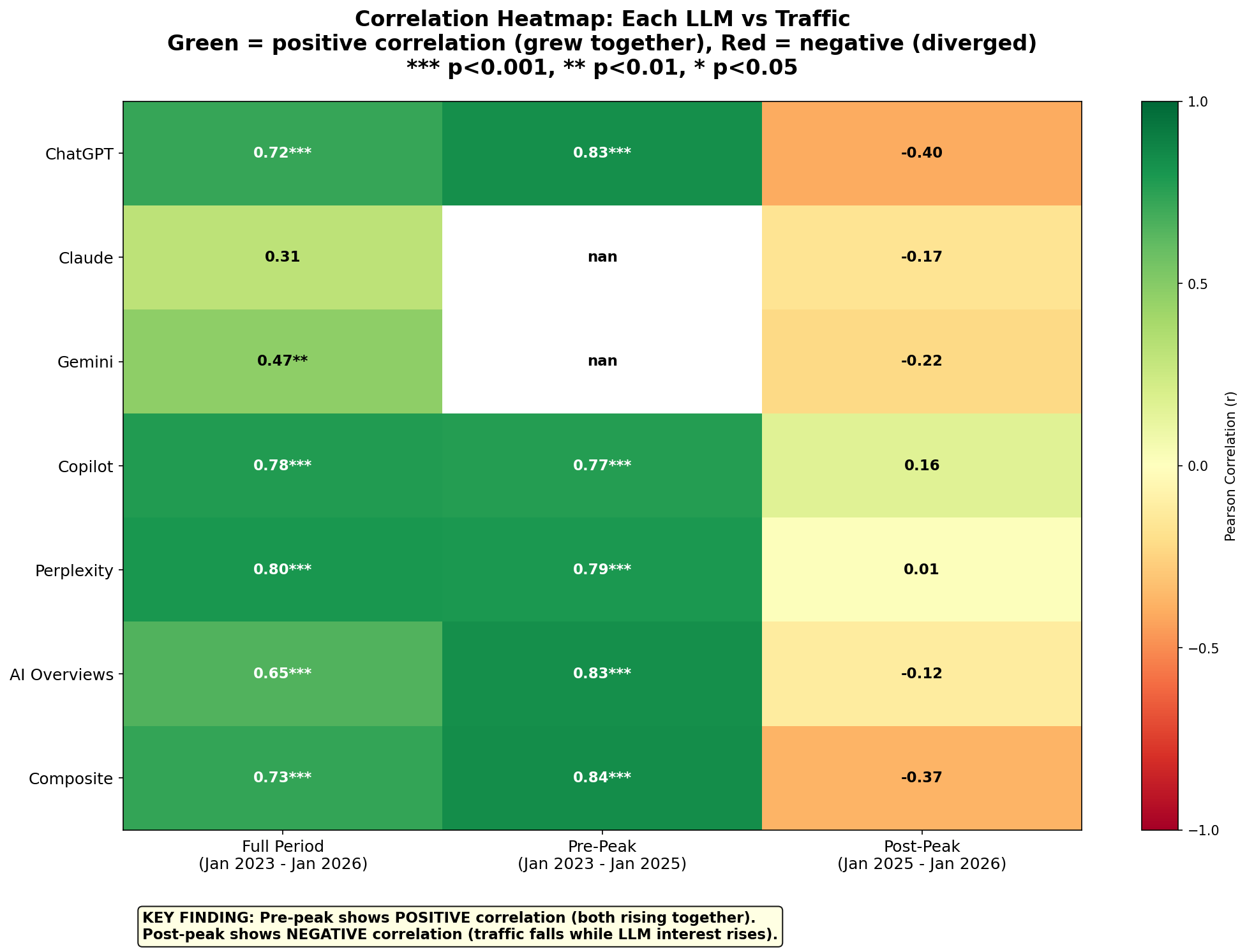
Figure 7e: Correlation heatmap across LLMs and phases. Green = positive, Red = negative.
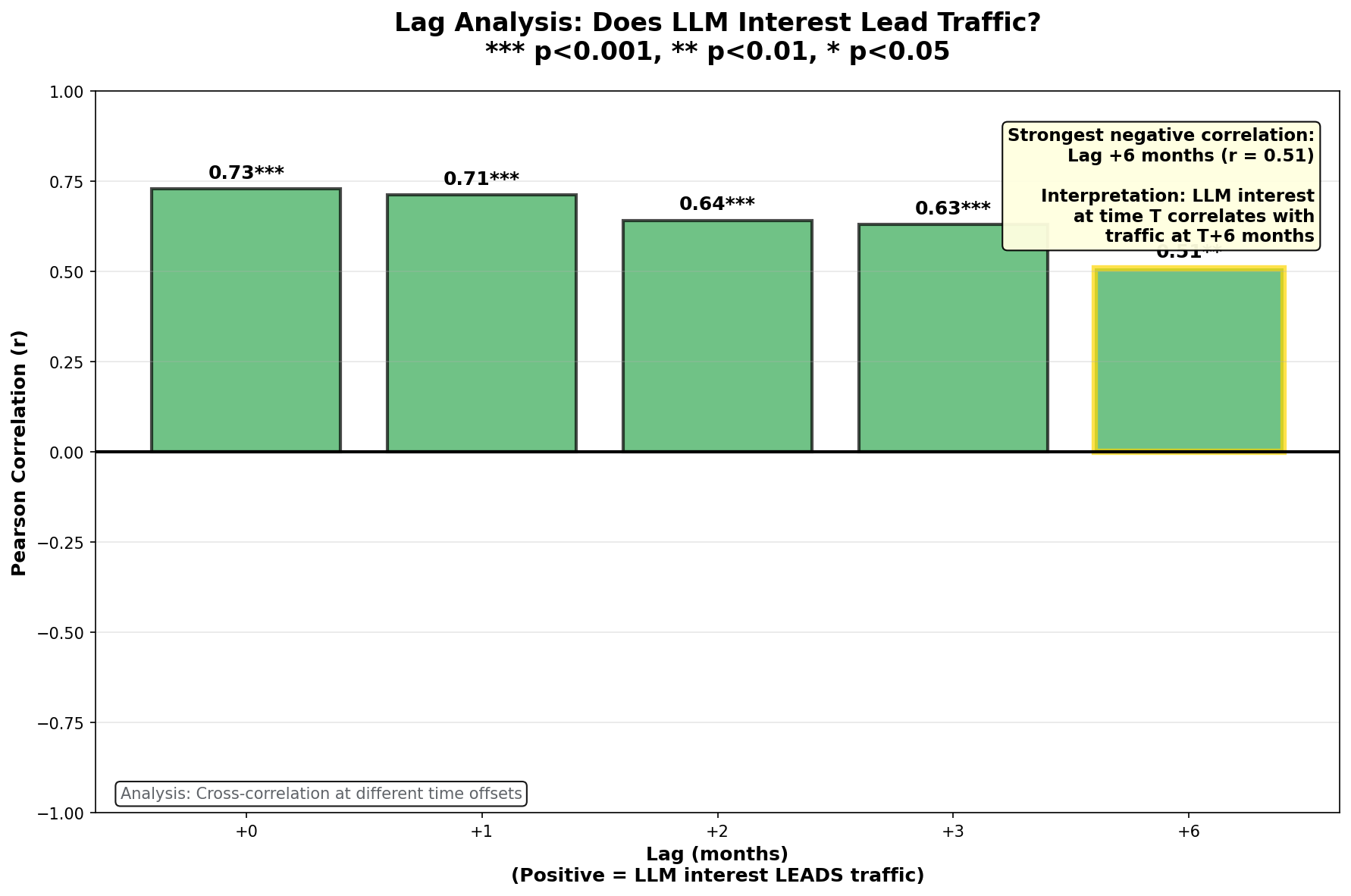
Figure 7h: Lag analysis - correlation at different time lags. Optimal lag: 6 months.
We run Interrupted Time Series (ITS) regression around March 2025 (AI Overviews Austria). This tests immediate level change and slope change.
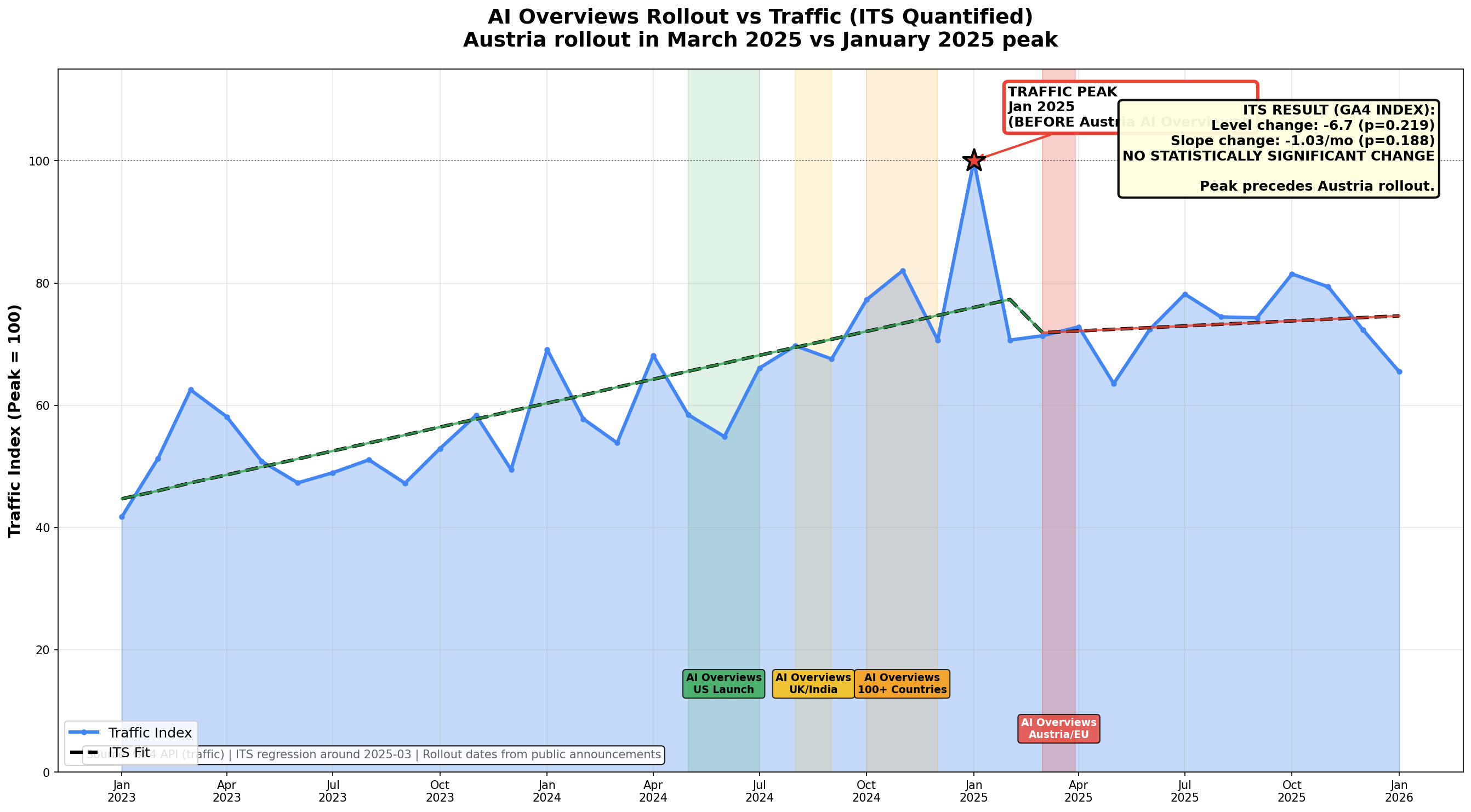
Figure 7g: GA4 traffic index with ITS fit. Level change: -6.7 (p = 0.219). Slope change: -1.03/mo (p = 0.188).
We validate the same event using GSC Search clicks (subset with Search Console access, n = 6, 2024-10-02 to 2026-01-23).
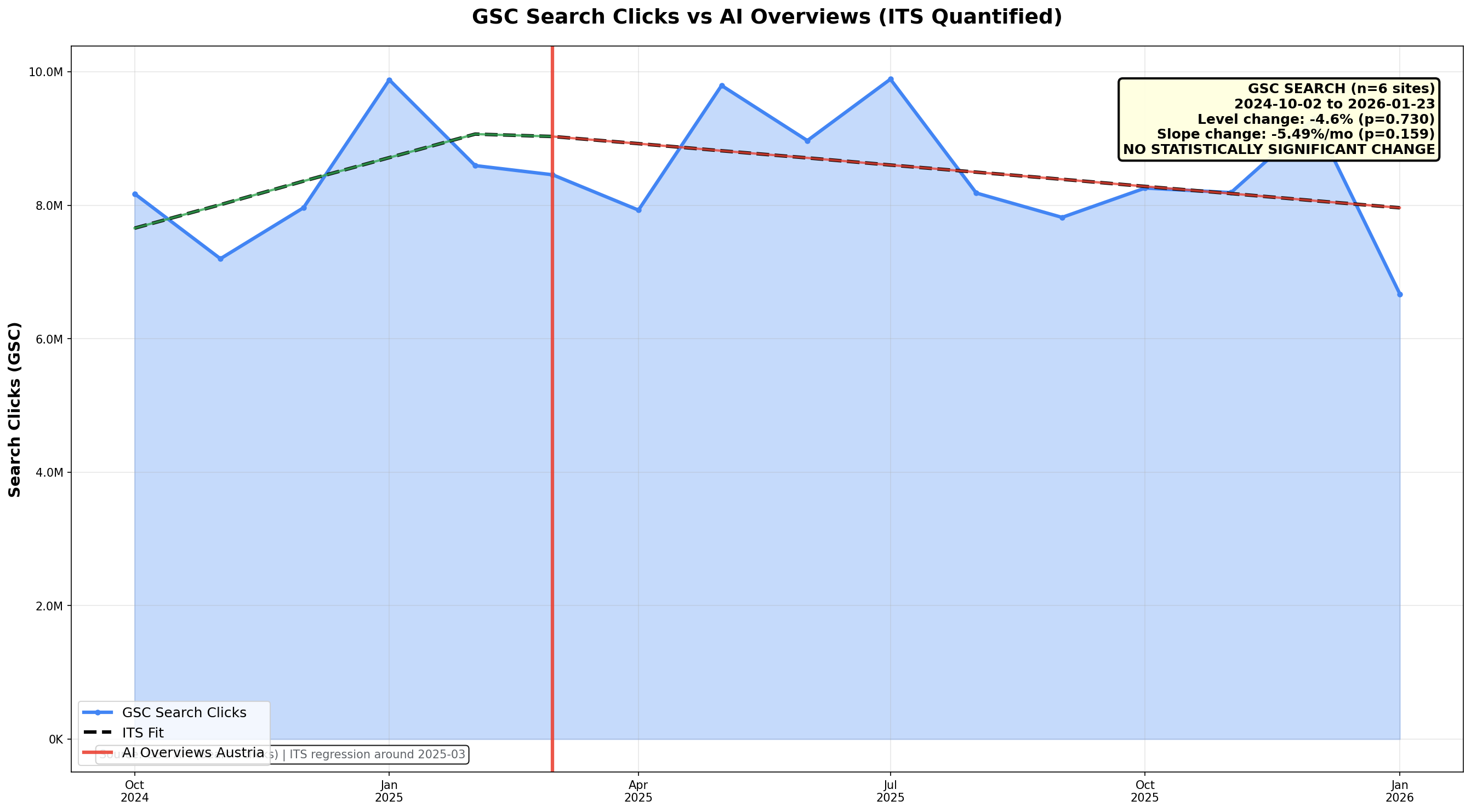
Figure 7k: GSC Search clicks with ITS fit. Level change: -4.6% (p = 0.730). Slope change: -5.49%/mo (p = 0.159).
| Hypothesis | Evidence Strength | Verdict |
|---|---|---|
| H1: LLM Chatbots | YoY correlation shifts; first-party referrals rising | WEAKLY SUPPORTED |
| H2: AI Overviews | GA4 ITS + GSC ITS around March 2025 | NOT PRIMARY CAUSE |
| H3: General AI Shift | Trend break + multi-factor evidence | MOST PLAUSIBLE |
To validate our findings, we examined whether broader industry data supports or contradicts the observed decline pattern. Each claim below is supported by at least two independent sources.
Chartbeat data shows Google search traffic to publishers declined 33% globally (38% in the US) from November 2024 to November 2025. This aligns with our finding of -35% from peak.
Sources: Press Gazette, Editor & Publisher
Pew Research Center found users clicked on results only 8% of the time when AI summaries appeared vs 15% without them (46% reduction). Seer Interactive reported a 61% drop in organic CTR for AI Overview queries.
Sources: Pew Research Center, Search Engine Land
SparkToro/Similarweb data shows 60% of Google searches now end without any click to a website. For news queries, zero-click searches rose from 56% to 69% between May 2024 and May 2025.
Sources: SparkToro, The Digital Bloom
Even market leaders experienced severe declines. HubSpot lost 70-80% of organic traffic. Forbes dropped 53% YoY. CNN declined 38% YoY. Business Insider fell 55% since 2022.
Sources: Search Engine Land, Taktical, Press Gazette
Analysis reveals that 73% of B2B websites experienced significant traffic loss between 2024 and 2025, with the average decline reaching 34% YoY - remarkably close to our observed -31% median.
Sources: KEO Marketing, The Digital Bloom
Media executives surveyed expect an additional 43% decline in search traffic over the next three years. NPR called it an "extinction-level event" for online publishers.
Sources: Search Engine Land, NPR
A study analyzing 40,000+ websites found organic traffic from Google decreased only 2.5% YoY - far less severe than Chartbeat's -33% for publishers. This suggests the decline may be sector-specific rather than universal.
Sources: Grow and Convert, Marketing4eCommerce
Google processes over 5 trillion searches annually (13+ billion daily) in 2025, up from 8.5 billion daily in 2024. Even with higher zero-click rates, the absolute number of clicks to websites may still be growing because the total search pie is larger.
Sources: TheeDigital, Neil Patel